
Ice Hockey Made Simple: Rules, Positions, and Olympic Action
Ice hockey is one of the fastest and most physically demanding team sports in the world. Played on a sheet of ice with razor-sharp ice skates and a hard rubber puck, the game blends speed, strength, strategy, and skill into a thrilling spectacle. For first-time viewers, hockey can feel overwhelming: the puck moves quickly, players change constantly, and whistles seem to stop play without obvious reasons. However, once you understand how the game is structured and why the rules exist, hockey becomes far easier to follow and far more enjoyable.
This guide is designed to give beginners a strong foundation by explaining how the game works, who plays which roles, and how rules shape the flow of play.
What Is Ice Hockey?
In case you've been living under a rock...ice hockey is a competitive team sport in which two teams attempt to score goals by shooting a puck into the opponent’s net using a hockey stick. Players skate across the ice at high speeds, often reaching over 30 km/h, making balance and agility essential skills. Unlike many sports where play slows down between actions, hockey is continuous and fluid, with teams rapidly transitioning between attacking and defending.
The puck itself is small, flat, and difficult to control, which adds to the challenge. Because of the speed of the game, players must think quickly, react instantly, and communicate constantly with teammates. This combination of physical effort and mental sharpness is what makes hockey so exciting and unpredictable.
How Is An Ice Hockey Team Structured?
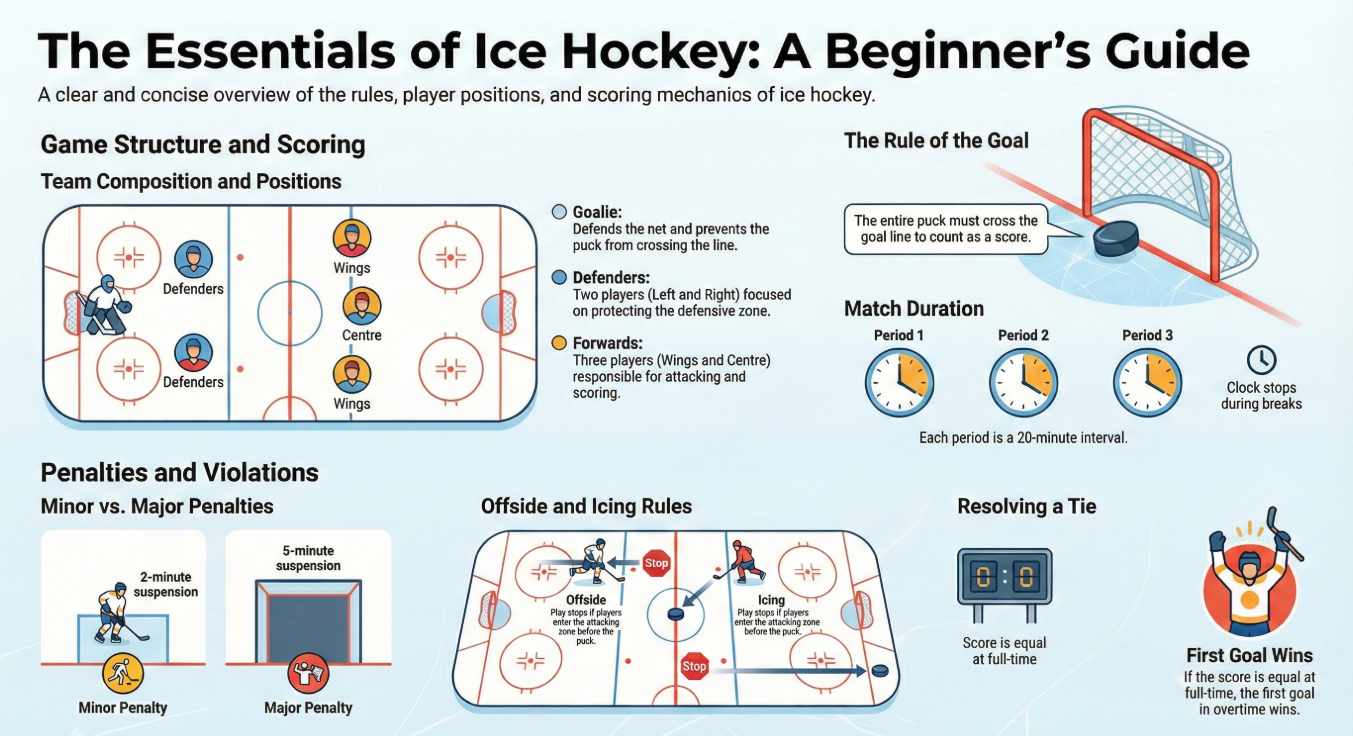
Each team can have up to 20 players available for a game, but only six players are allowed on the ice at one time. These players are divided into specialized positions, each with specific responsibilities that contribute to the team’s overall strategy.
The Goalie
The goalie is the most specialized position in ice hockey. Their sole purpose is to stop the puck from entering the net. Goalies wear extensive protective equipment, including large leg pads, gloves, and helmets, because shots can travel at extremely high speeds. A strong goalie relies on positioning, anticipation, and reflexes rather than skating speed. A single outstanding save can completely change the momentum of a game.
Defenders
Two defenders play in front of the goalie, one on the left and one on the right. Their main responsibility is to prevent the opposing team from creating scoring chances. This includes blocking shots, interrupting passes, and physically challenging attackers. Defenders also play an important role in offense by moving the puck out of the defensive zone and starting attacks with accurate passes or controlled skating.
Forwards
The three forwards are the primary attacking players on a hockey team and play a crucial role in creating and finishing scoring opportunities. The centre is often the most versatile of the forwards, taking face-offs, supporting the defence when needed, and directing offensive plays by distributing the puck and setting up teammates. The left and right wings work alongside the centre to apply pressure in the offensive zone, create space, and generate scoring chances, often positioning themselves to take shots on goal or capitalize on rebounds and passes.
Together, the forwards work to maintain puck possession and apply pressure in the opponent’s zone.
One of the defining features of ice hockey is unlimited substitutions, commonly called line changes. Players frequently switch on and off the ice during play to stay fresh, allowing the game to be played at an intense pace for the full duration.
How Ice Hockey Is Played
A game begins with a face-off at centre ice, where the referee drops the puck between two opposing centres. Face-offs are also used to restart play after stoppages, such as goals, penalties, or the puck leaving the rink. Winning a face-off can immediately give a team control of the puck, making it a key tactical moment.
Ice hockey is played in three 20-minute periods, rather than halves or quarters. Between periods, teams switch ends of the rink to ensure fairness. Importantly, the game clock stops whenever play stops. This ensures that the full 60 minutes consist entirely of active play, making time management and late-game strategy extremely important.
To score a goal, the puck must completely cross the goal line. Players must score using their hockey stick. While accidental deflections off the body are allowed, players cannot intentionally kick, throw, or direct the puck into the net with their hands or body. This rule emphasizes skill and control over chance.
Understanding the Ice and Zones
The ice rink is divided into three main zones, each with a specific purpose that helps organize play and maintain fairness. The defensive zone is the area where a team protects its own goal, and it is where defenders and the goalie focus on blocking shots, clearing the puck, and preventing the opposing team from creating scoring opportunities. The neutral zone, located at the centre of the rink, acts as a transition area between offence and defence; it is where teams regroup, change direction, and set up controlled attacks. The offensive zone is where a team attempts to score, applying pressure through passing, shooting, and sustained puck possession near the opponent’s goal. These zones are clearly marked by colored lines on the ice, such as the blue lines and centre line, which help referees enforce important rules like offside and icing. By defining where players and the puck can move, these zones keep the game structured, competitive, and flowing at a fast but fair pace.
Great Britain and Ice Hockey at the 2026 Olympics
Ice hockey is usually dominated by countries such as Canada, the United States, and Sweden, but Great Britain also competes internationally. With the 2026 Winter Olympics in Milan–Cortina approaching, British ice hockey continues to develop and aim for a place among the world’s best. Qualifying for the Olympic tournament is challenging, especially for nations where ice hockey is still growing, and teams must earn their place through international qualification events organised by the IIHF.
Although Great Britain is not guaranteed to qualify for the men’s ice hockey tournament at the 2026 Olympics, recent progress has been positive. Competing in top-level international tournaments has helped raise the standard of play and increase interest in the sport across the UK. For new fans, Team GB’s Olympic journey shows how ice hockey is becoming more global and how countries outside the traditional powers are continuing to improve and compete.
Ice Hockey Rules to Know
In Olympic ice hockey, two of the most important rules for beginners to understand are offside and icing, both of which help keep the game fair, fast, and skill-based. The offside rule prevents attacking players from entering the offensive zone before the puck crosses the blue line. If a player enters too early, play is stopped and a face-off takes place in the neutral zone. This rule encourages structured team play, accurate passing, and well-timed attacks rather than players waiting near the goal for easy scoring chances.
Icing is also strictly enforced in Olympic competition. It occurs when a player shoots the puck from behind the centre line all the way past the opponent’s goal line without it being touched. When this happens, play stops and a face-off is held in the defending team’s zone. Icing rules stop teams from simply firing the puck down the ice to relieve pressure and instead promote controlled play, endurance, and skill—key features of high-level Olympic ice hockey.